
An earlier post in this series introduced the backbone: a backend and a CMS to manage the platform and expose the APIs the apps would use. This post is about that system, and how it became much more than a place to keep recipes.
Why build our own
We explored the existing systems first. For our use case they were limited and costly, and adopting one meant being tied to it. We knew the product would evolve quickly, and the platform underneath had to stay in line at the same pace. Building our own gave us the control to do that.
What it is
The platform is a headless, API-first content platform. It stores and serves content, and leaves presentation to the apps built on top of it.
Under the hood it is deliberately boring: one modular service, FastAPI and Python on PostgreSQL, rather than a mesh of microservices. And it is stateless: state lives in the database or external services, so it can run as many identical replicas as demand needs.
What it does
Content comes first: creating, updating, publishing and deleting. Today the main content type is recipes, with their steps, ingredients, categories, tags, related items, SEO fields and assets, and the model is built so new content types can be unlocked per account.
Around that sit the people parts: accounts and sign-in, with age-aware flows including parental consent for under-13s; the social layer of follows, comments, reactions and sharing to public, follower or private audiences; and moderation and safety tooling.
Then the business of the app: billing, from subscriptions and trials to gifting and household plans; engagement, with rewards, badges and featured items; AI features, including recipe editing and search plus import from links and video platforms, with spend tracked per user; and media, served from the edge behind short-lived signed URLs.
Underneath all of it is the operational plumbing: usage metrics, audit logs, scheduled jobs, and an admin portal with role-based permissions. Apps talk to the platform through a typed TypeScript SDK, exercised by a harness that runs against a live API.

Flags and limits
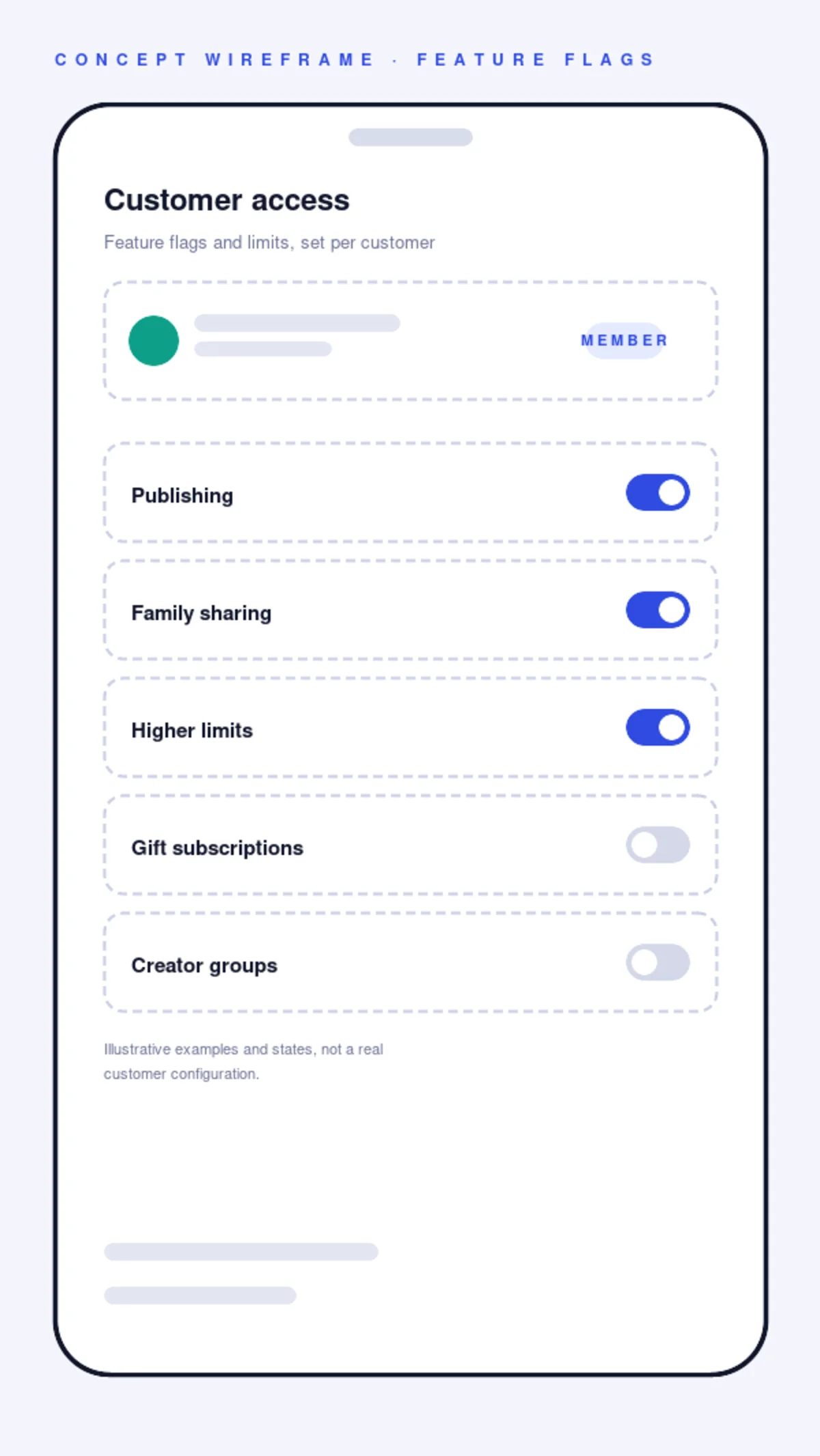
One pillar deserves its own mention. Every capability in the platform is a feature flag or an entitlement, resolved per request, so each user or plan gets its own feature set. Features can be enabled or disabled per customer, easily, as the product evolves.
That pillar is how the app's plans work today: a free plan, and a Member plan that adds publishing, family sharing and higher limits, as described on the app page. It is also how trials and gifting work. And it means the platform can hold more than any one customer ever sees: what is built and what is switched on are separate decisions.
What it deliberately does not do
The exclusions matter as much as the features. No front end: it returns data, not HTML, and apps decide how content looks. No microservices: new capabilities become modules inside the monolith. No silent breaking changes: routes are versioned, and removing or renaming a field means a new version. No personal data in logs or metrics. And no hand-edited schema or hotfixes: every schema change is a migration, every deploy goes through the pipeline, and production sits behind a manual gate.
That discipline is designed to let a small platform move at the product's pace, while keeping the apps that depend on it on stable ground.
Next in this series: how the delivery was planned. Come back soon to hear how we're progressing as we deliver the platform.